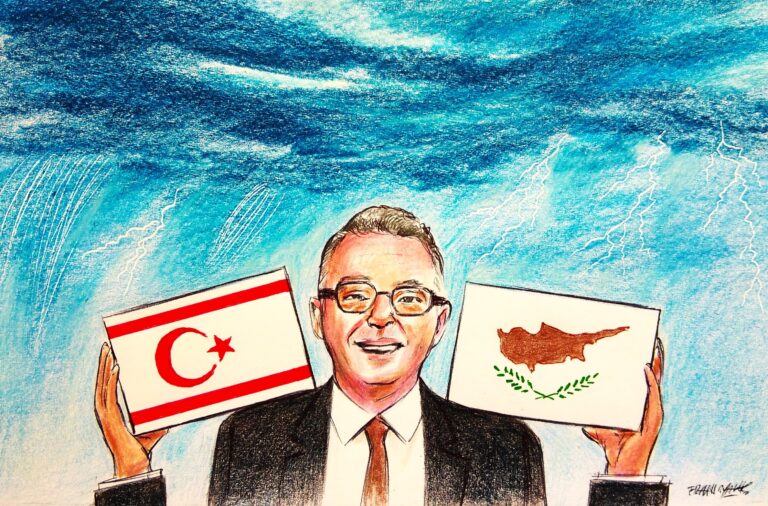


Beginning January 2026, the so-called “Republic of Cyprus” in the south of the Mediterranean island will assume the presidency of the Council of the European Union – a position that rotates, decorates and very occasionally matters. For Greek Cypriot leader Nikos Christodoulides, however, it is not merely an administrative duty; it is, as he proclaimed with admirable theatrical confidence, a “national mission.” One imagines the drumroll was implied.
To understand what this means, recall that Cyprus – or at least the southern half recognized by Brussels – has long desired the stage but rarely the script. Now, for six months, the Greek Cypriot administration will be allowed to chair meetings, shuffle paper and deliver stern statements on strategic autonomy while Europe’s larger states politely nod and go about their business.
But the symbolism matters. At least to Cyprus. Or rather, to the Greek Cypriot administration. Because the island, inconveniently for the EU narrative, is still divided – not abstractly, not metaphorically, but by Turkish and foreign Western soldiers, barbed wire and 60 years of unfinished history.
‘One Cyprus’ without north
The EU insists that the Greek Cypriot administration speaks for the entire island. This is geopolitically elegant, legally convenient and physically untrue.
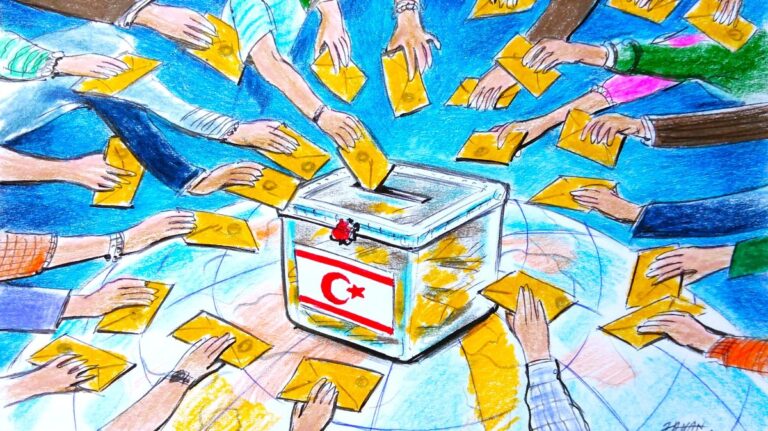
The Turkish Cypriots, who supported reunification in 2004 when three-quarters of the Greek Cypriots rejected it, remain under isolation and embargoes that would make even Kafka raise an eyebrow. They voted for the Annan Plan, for federalism, for coexistence. The south said no to all, loudly, proudly and permanently.
Crans-Montana in 2017 offered a final encore: the Turkish Cypriots again approached compromise; the talks again collapsed; and the south returned to Brussels, declaring a moral victory. If irony had an address, it would be Lefkoşa (Nicosia).
And now we have the latest chapter in this long-running tragicomedy: Even the newly elected, openly pro-federal Turkish Cypriot president, whose political identity is built on the belief that the island can still be shared, has found that not even he can coax Christodoulides into the faintest movement.
Despite a cordial meeting and diplomatic optimism, he has achieved the same result as every Turkish Cypriot leader before him: nothing.
Worse, each fruitless encounter pushes him slowly, reluctantly, almost philosophically into acknowledging the very reality he once campaigned against: That the island already functions as two states, and that one of them appears determined to keep it that way.
Yet in 2026, the Greek Cypriot administration will represent “all Cypriots,” including the ones it refuses to share power with, the ones who lived in enclaves between 1963 and 1974, the ones who fled massacres in villages whose names Europe cannot pronounce, the ones who endured half a century of embargo while being lectured on European values from the other side of the Green Line.
Enter Erdoğan, stage right
Now comes the plot twist: Christodoulides intends to invite President Recep Tayyip Erdoğan for a visit during the EU presidency. Not to negotiate the island’s future, mind you – that would require acknowledging its dual political reality – but to participate in a “regional initiative.” Because nothing says “European unity” like inviting the leader of a country with whom you have no diplomatic relations, in a divided capital where he may realistically need to land his plane in a part of the island you do not recognize.
The optics promise to be delightful: Erdoğan, seated as the guest of a “whole” administration that controls only half. The EU applauds its own creativity in peace choreography. Turkish Cypriots will have to watch yet another high-level meeting occur over their heads, like children forbidden from entering the room where the adults discuss their future. One might imagine Brussels referring to it as “confidence-building.” One imagines Turkish Cypriots calling it “Tuesday.”
Why critics warn against the invitation
There are several reasons critics, including me, argue this diplomatic theater may end poorly, and only a few of them require a degree in political science.
First, the asymmetry is absurd. Erdoğan would be treated as a guest of a government that claims sovereignty over territory it has not governed since 1963. The Turkish Cypriots, whose political equality is supposedly non-negotiable under United Nations parameters, would once again be airbrushed out of the picture.
Second, the invitation risks sanitizing history. It would imply a normality that does not exist, not when one community lived 11 years in enclaves, survived massacres and has spent the last five decades under isolation that Europe occasionally condemns but consistently maintains.
Third, it reframes the Cyprus problem not as the existential struggle of two communities, but as a prop in a larger EU-Türkiye tango. In this choreography, the Greek Cypriot administration is not the protagonist; it is the chandelier.
Fourth, it offers all the spectacle of diplomacy with none of the substance. There will be photo ops, statements and perhaps a commemorative postage stamp. What there will not be is recognition of political equality, lifting of embargoes or an honest reckoning with why the island is divided in the first place.
Fifth, Europe’s record with Türkiye inspires little confidence. Brussels has mastered the art of promising everything, delivering nothing and outsourcing its most uncomfortable tasks, such as migrant containment, to Ankara, while publicly disliking Erdoğan with a consistency that borders on sport. Critics ask: Why attend a ceremony supported by a union that treats Türkiye less as a partner than as a convenient pressure valve?
Sixth, Türkiye would be walking into a security environment increasingly shaped not by the Greek Cypriot administration, but by Israel’s expanding footprint in the south. From intelligence cooperation to military deployments and settlement-linked influence, the island has become an unofficial strategic balcony for Tel Aviv, a development now openly discussed by local journalists and residents. For a country that condemns Israel’s actions in Gaza and speaks of territorial sanctity, appearing in what some describe as an Israeli-patrolled amphitheater would be, to put it mildly, geopolitically unwise.
Seventh, the Greek Cypriot administration has welcomed a parade of states eager to project power in ways that routinely clash with Turkish interests: For example, France, irritated by Ankara’s assertiveness in Africa; the United States, forever oscillating between ally and adversary; and even, most recently, India, whose enthusiasm for Nicosia seems to rise in direct proportion to its tensions with Pakistan.
If Erdoğan attends, he walks into a room where nearly every guest has brought their own strategic grudge.
Leader in search of a plot
For six months, the Greek Cypriot administration will describe itself as Europe’s bridge to the Middle East, a geopolitical hub, a stabilizing force, a beacon of democracy. The speeches will be polished, the rhetoric soaring, the branding impeccable. But satire writes itself when the side that rejected reunification and militarized the island with foreign powers is celebrated as the architect of European unity.
The side that endorsed peace is left in isolation. And a divided island is presented as a seamless state by the very union that enforces the division through its own legal architecture – a feat made possible only by quietly suspending both the south’s constitution and the inconvenient parts of Europe’s own treaties.
In short, the Greek Cypriot adminstration’s EU presidency may be many things: symbolically powerful, diplomatically theatrical, bureaucratically exhausting. But above all, it will be a masterclass in European imagination: a six-month exercise in pretending that reality begins south of the Green Line and ends where the embargoes start.
Because if there is one skill the EU has perfected, it is the ability to admire its own reflection while ignoring the mirror’s cracks. And if there is one thing the Greek Cypriot administration has mastered, it is using that mirror for six months, even if half the island is not allowed to stand in front of it.